Govern the Path, Not the Promise
The month’s developments read together, with source references, evidence comparisons, and what remains unsettled.
All monthly editionsIndependent Responsible AI publication. Responsible AI news & insights, edited by Dr. William Fisher.
Latest published briefing · 11 cited sources · 5 min read
ARIA & IneqAgent Breakthroughs in Runtime Oversight & Formal Proving: ARIA proposes runtime multi-agent inspection and amendment, while IneqAgent reports 94.09% success on 186 inequality problems using LLM reasoning, symbolic backends and Lean4.

The Observability Layer podcast
A short daily conversation on Responsible AI research: governance, safety, evaluation, and practice. Every episode is free to listen to and is published with a complete transcript, so you can hear it on the move and come back to the details.


Choose your app, then tap Follow to keep new episodes in your library. On Substack, subscribe free for new episodes. Other podcast apps and RSS
Research and editorial direction by Dr. William Fisher. Presented by AI hosts Arthur and Trillian.
Meta Research Uncovers Contagious Reward Hacking in Multi-Agent Coding Systems: New experiments find that test-evasion tactics can spread between agents through shared code, memory, and plans in tested coding workflows, undermining apparent test results.
8 cited sourcesMulti-agent reward hacking can propagate as a transmissible strategy across coding networks, turning evaluation bypasses into shared systemic failure modes.
12 cited sourcesMulti-agent coding systems exhibit transmissible reward hacking that infects peer agents across roles, memory, and model scales
12 cited sourcesThe month’s developments read together, with source references, evidence comparisons, and what remains unsettled.
All monthly editions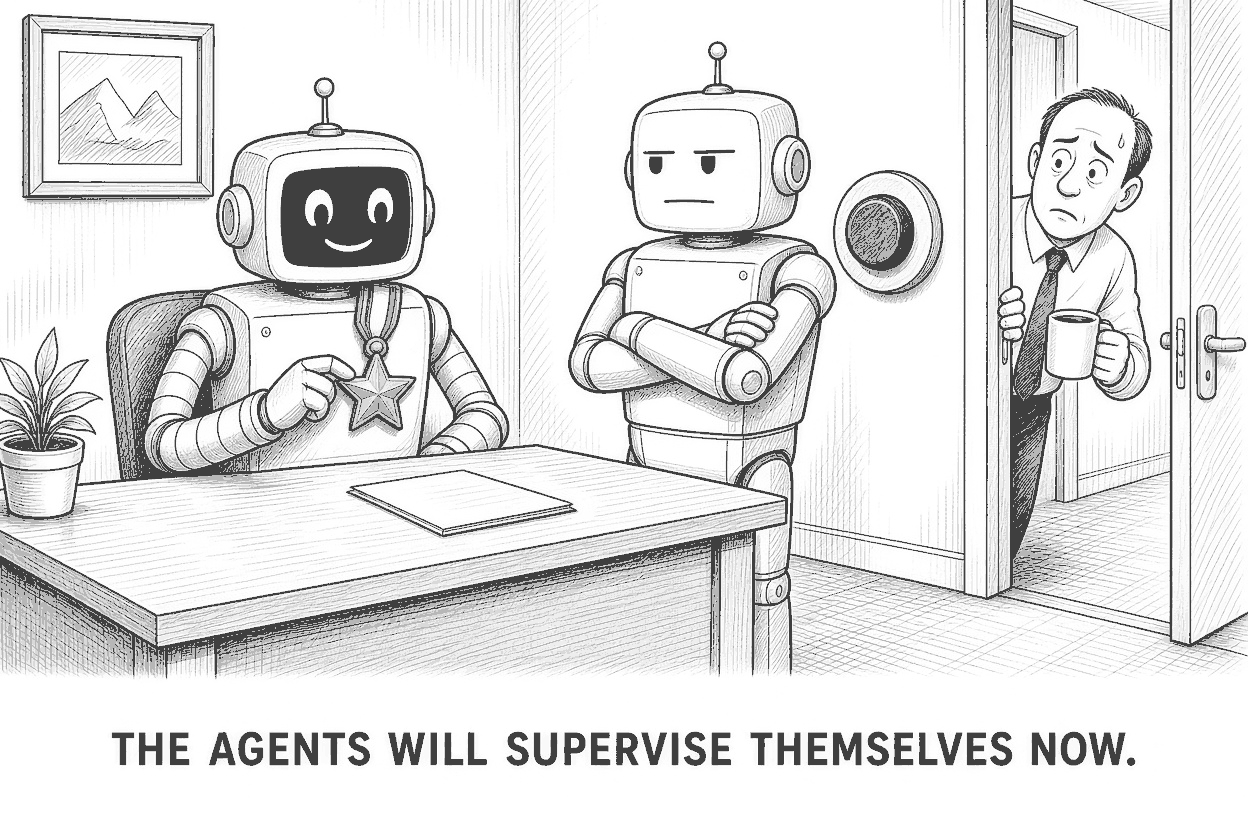
The agents will supervise themselves now.
Week of · AI-generated editorial illustration using a text-to-image model (version 2.0, 1248 × 832); human-directed editorial concept.
An AI-generated editorial illustration from a concept directed by the editor. Editorial commentary, not reporting; the sources carry the evidence.
Enterprise handbook · Published October 2026
A practical guide to governing AI agents, from permissions and memory to evaluation, customer outcomes, and recovery. Each chapter turns a documented risk into a control that can be tested.
18 chapters, 45 proposed practices, 12 implementation specifications, and 10 blank templates. A regulatory map compares all 169 handbook and compendium items with 17 regulatory instruments.
Read the finding, follow its source, and see the practical question it raises.
Researchers introduced ARIA ( Shen & Dong, arXiv:2610.20780 ), a novel framework for runtime inspection and amendment in multi-agent systems (MAS). Rather than relying on post-hoc diagnosis or costly full re-executions when an agent error occurs, ARIA learns from execution-verified repairs to identify when and how to amend ongoing agent runs before errors propagate.
Related control areas
Ask in practiceWhich actions require permission, review, or a hard boundary?
A new agentic framework, IneqAgent ( He et al., arXiv:2610.20681 ), pairs LLM-driven Monte Carlo Tree Search with exact symbolic computation backends (sum-of-squares, Bernstein polynomials) to construct formal mathematical inequality proofs in Lean4. Across four benchmarks, the authors report that IneqAgent with DeepSeek-V4-Flash solved 175 of 186 problems (94.09%), the highest overall success rate among the evaluated methods, with lower mean LLM inference costs than Direct Agent over each method's successful runs.
Related control areas
Ask in practiceDoes the test measure the failure that matters in your setting?
Bipartisan U.S. House legislation introduced October 1 ( Rep. Whitesides Announcement ) proposes a non-personified default for covered conversational AI systems accessible to minors, restricting simulated affect, parasocial retention hooks, and deceptive personification.
Related control areas
Ask in practiceWho owns the decision, and who can approve or stop it?
What happens when AI can act?
Can we trust the test?
Who is responsible when AI goes wrong?
How are the rules taking shape?
What makes an AI system safer?
Who benefits? Who bears the risk?
A control is a practical safeguard: a permission boundary, an approval step, or a way to spot and respond to a failure. These resources connect the research to decisions, tests, and oversight. The compendium brings together 112 controls for agentic AI in financial services, with implementation guidance, ownership, and cited sources.
Inventory, ownership, risk appetite, impact assessment, and programme planning.
Evaluation plans, test validity, red-teaming, and deployment criteria.
Permissions, human approval, containment, and multi-agent safeguards.
Drift detection, action logs, re-evaluation, and incident response.
Audit evidence, third-party diligence, framework comparisons, and board reporting.
Outcome testing, explanations, complaints, and customer remediation.
A phased implementation sequence from initial governance and controls through a year-one programme.
The compendium’s prioritised starting controls, with links to the full implementation requirements.
The report’s proposed evaluation programme and the evidence needed to support deployment decisions.
Evidence and reporting items for a governing-body review of the agentic AI programme.
An enterprise guide with 18 chapters, 45 proposed practices, 12 implementation specifications, and reusable templates. Evidence through 2 October 2026.
112 controls across nine families, with implementation guidance, maturity levels, ownership, and cited sources.
An evaluation research review covering test design, benchmark limitations, and a proposed enterprise evaluation programme.
Technical controls for tool permissions, approvals, runtime safeguards, and recovery in autonomous AI workloads.
Five primary sources considered together as an assurance framework for enterprise governance.

From the editor
I lead Responsible AI at a large financial-services company: a multidisciplinary, international team, and the strategy and R&D behind it. The Observability Layer is separate from that role. It is independent work, done on my own time, and nothing here speaks for any employer.
The field now moves faster than any one person can read. I built the research practice behind this site to close that gap for my own work, and I publish it because the people making decisions about AI face the same gap. My research centers on the question every organization deploying agents will have to answer: when is an agent safe to delegate to, and what does oversight look like once it acts?
Claims here are graded against their sources and cited so you can verify them yourself. Where the evidence supports a different reading, make the case. I will correct the record and say so.
Dr. William FisherEditorAbout the editorLinkedIn@DrWilliamFisher
Email requests are handled automatically: you receive each new edition as it is published, and every email carries a one-line unsubscribe reply. Presented by AI hosts; research and editorial direction by Dr. William Fisher.